Plan your visit
Frequently asked questions
On the phone
Where is the À Côté restaurant located?
À Côté is located at 16 rue La Fayette, in the 9th arrondissement of Paris. The restaurant is just behind the Opéra Garnier, near the Galeries Lafayette.
Is À Côté easy to get to?
Yes, the restaurant sits in a very central Paris neighbourhood, well served by public transport. It's a handy address for lunch or dinner near Opéra, place Vendôme, the department stores and central Paris.
Do you have valet parking?
The most comfortable way is to come and, above all, to leave without any driving constraint: between the prime rib, the wines and the digestifs, the meal can easily stretch out. For guests coming by car, there are several public car parks around the restaurant, better suited than the street for parking with peace of mind.
How do I book a table at À Côté?
You can book directly on the website or via the Google page — we work with Zenchef. I can also take your booking by phone. For large tables or special requests, just tell me directly or leave a note through the booking module. We'll do everything we can to make sure you have a great time.
Is booking recommended?
Yes, booking is recommended: you come without worrying about whether there's a table. You arrive at the agreed time, or you let us know your constraints and we adapt.
Can we come spontaneously?
Yes, with pleasure. A sudden craving for prime rib and you drop by À Côté — it's possible, our team always adapts. It's easier for us to manage bookings, but if the booking module doesn't fit your request, call us and we'll find a solution.
Can we book for more than four people?
Yes, large tables are possible. For groups over 8 people, contact the restaurant directly, as the booking module doesn't go beyond that — but we know how to handle large tables.
Is À Côté suitable for a group meal?
Of course. The concept of prime rib to share works very well for groups. Birthday, dinner with mates, meal with friends, team lunch or business dinner: the dish in the centre of the table naturally creates a convivial moment of exchange and sharing.
Is À Côté suitable for a business lunch?
Yes, À Côté is very well suited to a business lunch. The concept is clear, our team is professional, the service is attentive and discreet, the menu is simple with excellent products, the wine list offers 260 references so everyone finds their match, and the prime rib gives the meal a memorable character. Not to mention our 60 vintage Armagnacs.
Is À Côté suitable for a dinner for two?
Yes, the restaurant is very well suited to a dinner for two, especially for those who enjoy sharing a fine piece of meat and a good bottle. The atmosphere stays warm, lively and elegant. Our team will make sure you're in the best conditions to remember the moment.
Can we come with children?
Yes, children are welcome. Prime rib is easy to share as a family, and the team helps choose the right weight according to age, appetite and the number of guests. Our wonderfully crispy fries delight young and old alike.
How much time should we set aside for a meal?
Set aside the time for a real meal at the table. Prime rib requires careful cooking, then it's shared calmly with the homemade fries, the sauces, the wine and the desserts.
Can we have lunch at a specific time?
Yes, just tell the team your timing as soon as you arrive. The service can guide you to the right pace, while respecting the cooking and the quality of the meal.
Is the restaurant wheelchair accessible?
Yes, of course. The restaurant is accessible to people with reduced mobility, the toilets are adapted, and we can arrange a comfortable table for your visit.
I'm on my own, can I come to À Côté?
Yes, of course. You're absolutely welcome to come alone to À Côté. Our booking module starts at two people, because our restaurant is built around prime rib to share. For a single person, a prime rib can be a generous portion: even looking for the smallest pieces, it's rare to find one under 800 to 900 g. That's why we prefer that you call us directly. It lets us anticipate your visit, inform the kitchen and, when possible, set aside a prime rib at the most suitable weight for you. Some guests come alone, choose a fine rib, a glass of wine, sometimes a digestif, and have a very good time. The main thing is simply to talk to us before your visit, so we can welcome you in the best conditions.
Do you have a terrace?
À Côté welcomes you in a comfortable dining room. The restaurant is air-conditioned and the noise level is kept in check. It sits on rue La Fayette, in the heart of a very central, lively and festive Paris neighbourhood, near the Opéra Garnier and the Galeries Lafayette. It's a busy street, with lots of foot traffic, movement and Parisian energy. So we chose to favour the comfort of the dining room: a well-set table, a pleasant temperature, prime rib served hot, wines at the right temperature, attentive service, and a moment you can really take the time to share. On hot, rainy or unpredictable days, À Côté becomes a real refuge in central Paris: you leave the street noise outside, settle in, have a drink, share a fine prime rib and simply enjoy the meal.
Is the restaurant air-conditioned?
Yes, the restaurant is air-conditioned. On very hot days in Paris, our dining room becomes a real refuge in the heart of the 9th arrondissement, on rue La Fayette, near the Opéra Garnier and the Galeries Lafayette. You settle in the cool, away from the noise and bustle of the street, in a comfortable atmosphere. It also matters for fully enjoying the meal: prime rib served nice and hot, wines at the right temperature, attentive service and a moment you can take the time to share. When Paris gets stifling, our air-conditioned restaurant can be even more pleasant than a shaded terrace: less noise, less heat, more comfort, and the whole À Côté experience around prime rib and wine.
At the table
Why prime rib and not something else?
Prime rib perfectly sums up the spirit of À Côté: a fine product, a lively table and a true moment of sharing. The prime rib arrives in the centre of the table. It's shared, pairs with a good bottle, invites conversation, taking your time, and setting phones aside. It's a deeply French dish, generous and convivial, and that's exactly what we want to champion. This choice also has a personal story. Antoine and I are attached to the Limousin region. So we chose a French beef breed: the Limousine, from animals raised on grass and hay, with a supply chain we know and control. In the kitchen, this stance brings us back to the essentials: little processing, no artifice. Everything rests on the quality of the meat, the precision of the cooking, the Maillard reaction, the homemade fries, the sauces, the wine and the service.
What is À Côté's speciality?
À Côté's speciality is prime rib to share. It's served with homemade fries, a green salad, sauces and a bone marrow, in the spirit of a true French table.
Do you have anything other than prime rib?
Yes. Prime rib is the heart of À Côté, but we also offer a few starters to share, a fine cheese plate and desserts according to the Chef's inspiration. The idea stays the same as for the meat: very good products, little processing, well-mastered recipes and a lot of sincerity on the plate. Our foie gras is prepared from livers from the Landes, seasoned with Espelette pepper. We also offer a wild pork terrine with pearl onions, or little sardinellas from the Basque Country. We work with French products, chosen for their quality, origin and taste. At À Côté, we prefer to keep things simple, right and good: fine products, well selected, well prepared, and served in a spirit of sharing.
How do we choose our prime rib?
The prime ribs are offered according to the weights available at service time. The team helps you choose the piece best suited to the number of guests, your appetite and the doneness you want.
There are 2 of us, what weight do you recommend?
For two people, we generally recommend a prime rib of around 900 g to 1.2 kg. The weight includes the bone, and the team adjusts the recommendation according to your appetite, the doneness you want and how the meal unfolds. Consider a starter to share while you wait for your prime rib.
There are 3 of us, what weight do you recommend?
For three people, a prime rib of around 1.3 kg to 1.6 kg is often ideal. The choice depends on your appetite and the doneness you want. Consider sharing 1 or 2 starters while you wait. Have an aperitif while your bottle of wine breathes, and you'll have a great time.
There are 4 of us, should we take 1 or 2 prime ribs?
For 4 people, a very fine rib can be enough: the weights of our prime ribs are shown on the board and can exceed 2 kg. The team will guide you according to your appetites, the doneness and the balance you want at the table. That said, if you're very, very hungry, you can take 2 prime ribs.
Does the stated weight include the bone?
Yes, the prime rib weight includes the bone, as for any prime rib sold by the piece. At À Côté, our ribs aren't cut Tomahawk-style, with a very long, deliberately spectacular bone. We keep the bone as reasonable as possible, because the rib is sold by weight and we want the guest to pay above all for fine meat. The bone is naturally part of the piece, its cooking and its presentation. Our team simply advises the most suitable weight according to the number of guests and your appetite.
Can we choose a big prime rib even if there are only 2 of us?
Yes, of course. At À Côté, you're free to choose the prime rib you fancy. Our team gives guidance according to the number of guests and appetite, but the decision is yours. We've even served two guests who each took a 1.4 kg prime rib… and finished them. It's generous, but after all, everyone knows their own appetite. Our advice is simply to find the right balance: a fine prime rib to share, maybe one or two starters to begin, and a little room to finish with a dessert. The idea is for the meal to stay a true moment of pleasure, from start to finish.
Can we ask for a specific doneness?
Yes, the doneness you want is asked for when you order. Prime rib is a thick piece: the team makes sure to respect your preference while preserving the juice, texture and taste of the meat.
What doneness do you recommend?
To fully enjoy a prime rib, we generally recommend cooking between rare and medium, what English speakers often call medium rare. This doneness keeps the juice, the tenderness and the character of the meat, while letting the fat start to melt to bring its taste and richness. Prime rib is a generous piece, with fat, and that's also what makes it interesting. Cooking too blue or too cold can be less suitable, as it doesn't always give the fat time to express itself fully. Of course, every guest has their preferences, and our team helps you choose the doneness that suits you best.
Can two different donenesses be done on the same prime rib?
Yes, it's possible. When 2 people want to share the same prime rib with different donenesses, we can cook the whole piece on a rare base, then take a few pieces back to the kitchen to bring them towards a more medium doneness. This lets us serve one and the same prime rib, with a rare part and a more cooked part, according to everyone's preferences.
Is the prime rib served sliced?
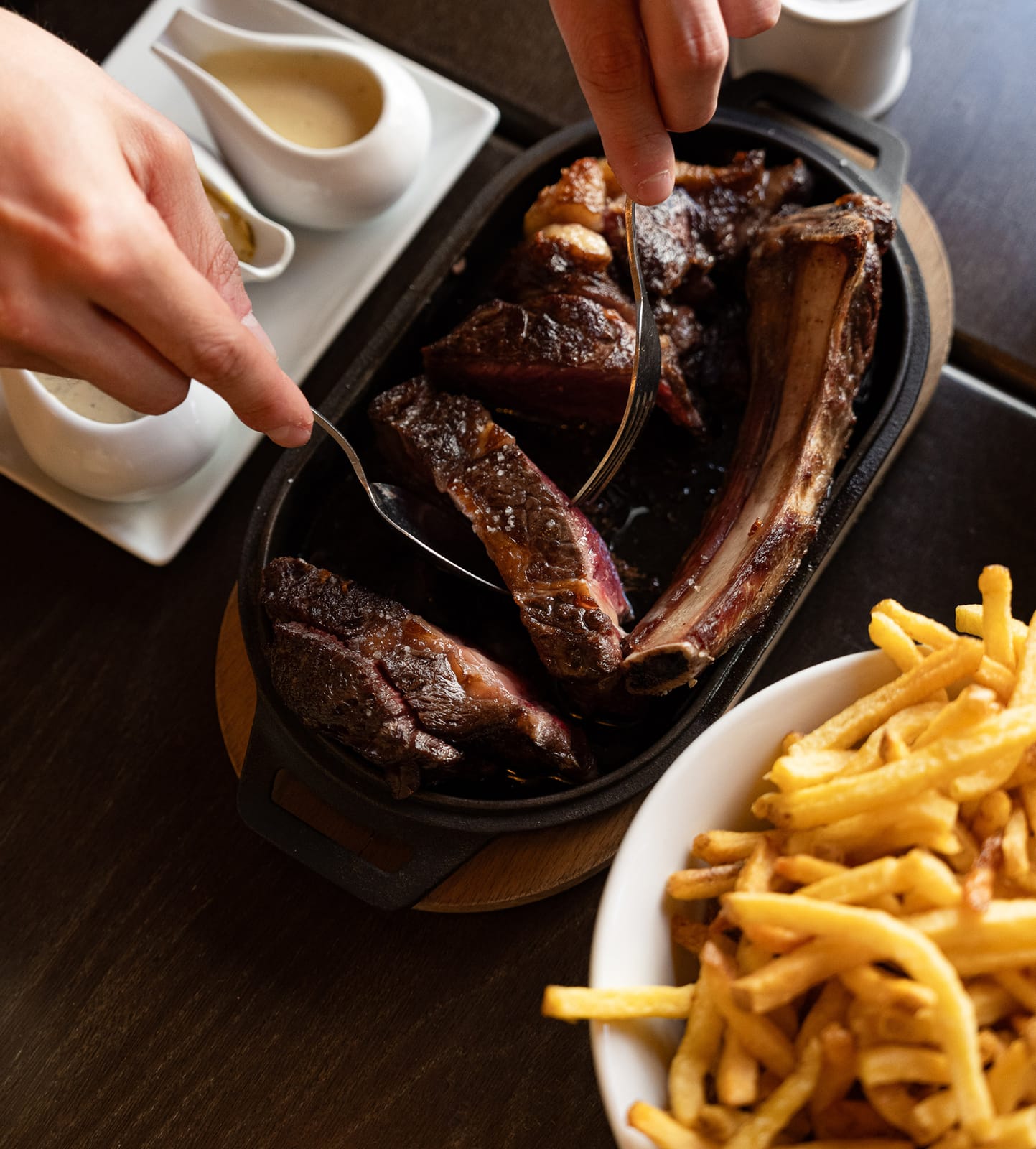
Yes, the prime rib is served sliced in a cast-iron pan to make sharing easy. Everyone can simply help themselves and enjoy the meat, the homemade fries, the sauces and the bone marrow.
What sides are served with the prime rib?
The prime rib is served with homemade fries, a green salad, Roquefort, Pepper and Béarnaise sauces, and a fine bone marrow.
Are the fries homemade?
Of course, the fries served at À Côté are homemade. They're part of the experience: a fine prime rib, precise cooking, generous sauces and simple sides. And our fresh, crispy fries.
What sauces do you offer with the prime rib?
We have a Roquefort sauce, a pepper sauce and a Béarnaise. All our sauces are homemade. For children, we also have ketchup.
The product
Where does your meat come from?
À Côté works exclusively with French meats from beef breeds, in particular the Limousine. Our animals are raised, fed and slaughtered in France. They are grass- and hay-fed, what English speakers call grass-fed beef. It's an essential choice for us, because feed, farming and origin are found directly in the taste of the meat. We look for a prime rib that's tender, generous, with character, fat, juice and that depth found in fine French meats. For us, a good prime rib begins first in the meadows, with well-raised animals and a supply chain we know.
Why did you choose the Limousine breed?
The Limousine breed is known for the quality of its meat, its balance and its taste. It matches the spirit of À Côté: French meat, sincere, legible and suited to a fine prime rib to share.
Is your meat grass-raised?
Yes. The animals we select are grass- and hay-fed, what English speakers call grass-fed beef. It's non-negotiable for À Côté. The animals grow in the fields, graze naturally, and this feed is found directly in the meat: a fine colour, juice, tenderness, freshness and a truer taste. For us, a good prime rib begins before the kitchen: it begins in the meadows, with well-raised, well-fed animals and a French supply chain we know.
Is your meat aged (matured)?
We work with fresh meat, selected for its natural taste, its juice, its fat and its tenderness. Ageing is a fine approach, but it often seeks extra tenderness and more pronounced, sometimes slightly gamey aromas. At À Côté, we prefer a more direct reading of the product: French meat from a beef breed, notably Limousine, raised on grass and hay. These animals are made to produce fine meat. Their feed, their pasture farming and the quality of the supply chain already naturally bring what we look for: tenderness, taste, juice and real depth. Our choice is simple: serve a fresh prime rib, well raised, well selected, then cook it with precision to fully reveal its character.
Why don't your prime ribs all weigh the same?
Because we work with a living product, not a standardised one. We receive racks of prime rib, made up of 5 ribs, whose weight generally varies between 5 and 9 kg depending on the animal. Then each rib is cut respecting the natural position of the bone. For all the ribs to weigh exactly the same, all the animals would have to be identical, have the same build, each rack would have to be perfectly alike and the space between each bone always the same. That can exist, but not really in nature. It's also what makes the service charming: the team shows you the available weights and helps you choose the rib best suited to your table.
How do you cook the prime ribs?
We cook our prime ribs simply, with no added fat, no salt, no pepper to start. The meat must first speak for itself. The rib is laid on a very hot plancha, first on its fattiest edge. The fat starts to melt gently, then we sear each side in this natural fat. The rib doesn't move: this is how a beautiful golden, deep, almost caramelised crust forms. This is the famous Maillard reaction, the one that gives the meat that grilled, mouth-watering, irresistible taste. Then the rib rests. This time is essential: it lets the juices spread through the meat and the piece gain tenderness. At service time, we carve it, plate it in a cast-iron pan, then it spends a few minutes in a very hot oven at 240 °C just to warm it through. The result we look for is simple: a well-marked crust, juicy meat, melted fat, flavour, and that smell of grilled prime rib that reaches the table before the dish itself.
Why cook the prime rib on a plancha?
The plancha allows precise, clean and even cooking. It helps us form a fine surface crust while keeping the juice and tenderness of the meat. It's also very well suited to our prime ribs, which are naturally generous in fat. When that fat melts, it stays in contact with the meat and feeds the cooking. It brings taste, richness and contributes to the beautiful caramelisation we look for. With open-flame cooking, some of that fat would drip and burn. On the plancha, we keep more controlled cooking, without direct contact with the flame, with well-seared meat, melted fat and a perfectly marked Maillard crust.
What is the Maillard reaction?
The Maillard reaction is what gives the prime rib that fine grilled, golden and fragrant crust. Technically, it's a natural reaction that happens during cooking between the proteins of the meat and the sugars on the surface. Under the effect of heat, the meat colours, the aromas develop, and this delicious crust appears. It's this reaction that brings the grilled taste, the depth, the richness and the contrast we love so much: a well-seared, almost caramelised surface, and meat that stays juicy inside. Its name comes from Louis-Camille Maillard, a French chemist who described this reaction in the early 20th century, in 1912. At À Côté, we deliberately seek it out: a very hot plancha, the natural fat of the rib, patience, resting, then a finish in the oven. It seems simple, but that's where a large part of the taste is decided.
Wine
Do you have a large wine list?
Yes, À Côté places real importance on wine. Our list offers many references, with accessible bottles, wines for pleasure, fine classics and a few rarer gems. The idea is simple: to help you find the right bottle to go with the prime rib, according to your tastes, your budget and the moment you want to have. Whether for a lunch, a dinner with friends, a special occasion or simply the urge to treat yourself, our team advises you to choose the most fitting wine.
Do you offer wines by the glass?
Yes. À Côté offers a selection of wines by the glass with 5 reds, 3 whites and a Côtes de Provence rosé. These same wines can also be served by the pichet. They're real wines from our list, served from bottles selected by the restaurant. The idea is to offer quality wines by the glass, able to accompany both the aperitif and the prime rib. And when a bottle from the list particularly tempts you, we can also, depending on the reference, offer it "à la ficelle": you enjoy the bottle at the table, and it's billed according to what you actually drink.
What wine do you recommend with a prime rib?
With a prime rib, we often recommend a red wine with structure, fruit and a fine length. Bordeaux, Burgundy, Rhône, Loire or other regions can go very well with the meat according to your tastes.
Do you have foreign wines?
À Côté chooses to focus on French wines. Our list has around 260 references, with a fine selection of regions, colours, grape varieties and styles found in France. It's our playground, our culture, and above all a field where we have real connections and genuine expertise. We prefer to offer what we know well, what we know how to choose, appreciate and recommend accurately. The idea is to accompany the prime rib with wines we truly master, from pleasure wines to the finest bottles. France already offers immense diversity: Bordeaux, Burgundy, Rhône, Loire, Languedoc, Provence, Alsace, Beaujolais, Corsica, Champagne… This lets us build a rich, coherent list designed for the À Côté table.
If we have a bottle for the aperitif then another for the prime rib, what do you recommend?
For the aperitif, we can point you to a fresher, lighter or more taut wine: a white, a champagne, a rosé or a delicate red according to your wishes. To go with the prime rib, we then recommend a more structured red, with depth, fruit, spicy or peppery notes, and enough roundness to match the power of the meat and the richness of the sauces. Our advice: choose that second bottle at the start of the meal. It lets us open it, decant it if needed, and give it time to breathe. A fine wine often gains from opening up quietly before arriving with the prime rib.
Can we start with a champagne?
Yes, of course. Champagne can open the meal very well, as an aperitif or with a starter to share. À Côté offers a fine selection of champagnes, with a preference for vinous champagnes, those that behave like real wines: deep, elegant, able to accompany a meal and not just launch the aperitif. The best is to take a look at the list and talk to us about it. Depending on your wishes, we can point you to a fresh, taut, richer or more structured bottle. And champagne can also come back very well at the end of the meal. After a prime rib, it brings freshness, energy and a lovely way to extend the moment.
Can we drink a white wine with the prime rib?
Yes, of course. Some characterful white wines can go very well with a prime rib, especially when they have body, tension, length and enough depth to answer the meat. But the most important thing is your taste. A good pairing is first of all a wine you feel like drinking. Talk to us, tell us what you like, what you expect, the atmosphere of the meal you want, and we'll guide you. We can even suggest a rosé with a prime rib. Not a very pale, light rosé, but a true gastronomic rosé, like a Bandol rosé from Domaine de la Bégude: a coral colour, structure, power, tannins, and a real ability to accompany the meat. At À Côté, the perfect pairing isn't a fixed rule. It's the one that gives you the best time.
Do you offer rare wines or fine bottles?
Yes. À Côté's wine list includes pleasure bottles, fine classics and rarer references. We also like to offer sourced wines, produced in small quantities, sometimes hard to find elsewhere. Bottles chosen with care, for their taste, their story, their winemaker or simply because they can create a real moment at the table. The idea is to let you pair a fine prime rib with a wine out of the ordinary, according to your wish, your budget and the occasion.
What is your best wine?
Pétrus! More seriously, even if it's obviously an exceptional wine, the best wine depends above all on you. It depends on your tastes, the moment, the season, what you're eating, your mood, sometimes even tiredness or the heat of the day. A great wine on paper isn't always the most fitting wine for a table. At À Côté, all the wines on the list are selected with care. Then the right choice is very personal: some will like a powerful, deep wine, others will look for more freshness, fruit, finesse or richness. The best wine, in the end, is the one that tempts you, that goes well with your prime rib, and that makes your meal even better. Our role is simply to help you find it.
Do you offer digestifs after the meal?
Of course. À Côté offers a fine selection of digestifs to extend the meal after the prime rib. We love those ends of the table where you take a little more time, where the conversation continues, where you choose one last glass to accompany the moment. The list features vintage Armagnacs, some very old, Chartreuses, Michel Couvreur whiskies, Rémy Martin cognacs, up to the legendary Louis XIII, as well as rums and a few carefully chosen spirits. The idea is simple: to end the meal with elegance, indulgence and pleasure. A fine prime rib, a good bottle, then a digestif to extend the moment… At À Côté, we have what it takes to make the moment last and, sometimes, touch the angels.
You have Chartreuses, but do you know the VEP?
Yes, of course. À Côté offers a very fine selection of Chartreuses: Yellow, Green, MOF, Élixir, 9th Centenary, as well as the Green and Yellow VEP. The VEP (Vieillissement Exceptionnellement Prolongé — Exceptionally Prolonged Ageing) is among the great bottles of Chartreuse. These are rare flasks, with quite exceptional depth, complexity and length. We receive very small allocations each year, generally two bottles of Green VEP and two bottles of Yellow VEP. We serve them in large iced digestif glasses, with the ice cubes on the side, so everyone can adjust the coolness to their taste. It's a very fine way to end the meal, especially after a prime rib and a good bottle of wine.
Do you have natural, organic or biodynamic wines?
Yes. Our list offers natural wines, organic wines and biodynamic wines, with some Demeter-certified references. An organic wine is made from grapes grown without synthetic chemicals. A biodynamic wine goes further in the attention paid to the vine, the soils, the natural cycles and the living balance of the estate. A natural wine seeks the most direct possible expression of the grape and the terroir, with very little intervention in the cellar. At À Côté, what interests us above all is the right taste: the taste of a grape, a terroir, a vintage, the sun, the wind, the soil, but also the winemaker's work. We like wines that tell a story, without needless artifice. Sincere, living wines, able to accompany a prime rib with character, freshness or depth according to your wishes.
Do natural wines always have a particular taste?
Not all natural, organic or biodynamic wines are alike. A successful natural wine must remain a clean, precise, living wine that's pleasant to drink. It can have more freedom, more energy, sometimes a more direct expression of the grape and terroir, but it must stay under control. Certain flaws, like overly animal smells, a mousy taste or an unpleasant sensation in the mouth, aren't the signature of a great natural wine. They're simply the signs of a poorly mastered wine. That's why we select these bottles with care. We seek to know the winemakers, their work, their standards and their consistency. At À Côté, an organic, natural or biodynamic wine must first of all be a good wine: sincere, well made, pleasant to drink, and able to accompany the pleasure of the table.